
Κ.3.3.
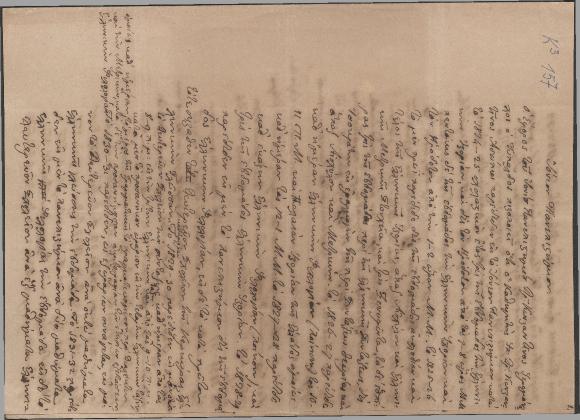
Correspondence of Konstantinos regarding the teaching of his courses at the Ionian Academy as well as documents concerning the operation of the Academy, student checks, curricula.
ManuscriptIonian Academy. On May 17, 1821, the Ionian Parliament issued a resolution for the establishment of the Academy in Ithaca, but on May 29, 1823 the Parliament decided that the seat of the Academy should be in Corfu. and authorized the government to arrange for the opening of the university from the academic year 1823-1824, with four faculties: Theology, Philosophy, Law and Medicine. The reason that Corfu was finally chosen as the seat of the university was that it had a hospital, a prerequisite for the operation of a medical school, courts that would serve the purpose of a law school and buildings in which it could be housed. In addition, the war for Greek independence had begun and Ithaca was very close to war-torn Greece and far from the control of the commissioner. Each school would award the following degrees: a) Doctor, b) Master of Arts, c) Scientist (Bachelor). Students in the first and second years of study did not belong to any particular faculty and were called philologists, except for students of Theology who had taken the blessing and were called Readers.After Guilford's death the duties of Lord of the Academy were assumed by a three-member "General Committee on Public Education". This was followed by a reduction in the budget of education by the Senate, the establishment of a seminary in 1828, which limited the operation of the Theological School, and the suspension of the operation of medicine, which reopened in 1844, when Lord John Colborne, Baron of Seaton, was Commissioner. Also after Guilford's death, the British abolished the Greek common language from the university's traditions and replaced it with Italian. In 1849 the Greek language was again recognized as official.
Cephalonia